
His music connects to your soul in an inexplicable way. It reawakens hidden emotions and makes you feel alive again. It takes you back in time to a faded memory and refreshes it. It transports you beyond yourself, momentarily making you forget your mortal existence, as you become one with the universe. It is exquisite.
Two Academy Awards, two Grammy Awards, a BAFTA Award, and a Golden Globe Award – barely scratch the surface of A R Rahman’s extraordinary musical journey. Neither he nor his music needs any introduction as his distinct sound is his signature.
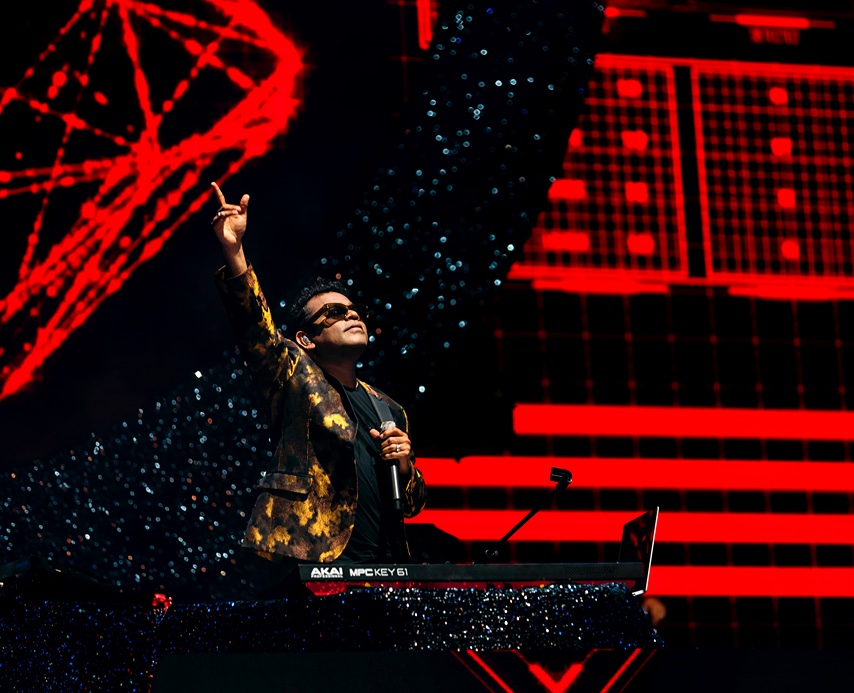
A music prodigy, he started learning the piano at age four, playing in orchestras at age 11 and was soon mesmerising audiences worldwide with his soulful compositions and innovative soundscapes. While iconic scores for films like Slumdog Millionaire and “Jai Ho” have made him a household name, they barely scratch the surface of his repertoire.
His Firdaus Orchestra, a collective of talented musicians from around the world, has been instrumental in bringing his unique vision to life. But it is his live performances that are legendary! The mesmerising visuals, intricate arrangements, and palpable energy leave audiences spellbound.
The Middle East boasts a rich tradition of unique instruments. Are there any particular instruments from the region that you find particularly fascinating or that you’d love to incorporate into your music?
AR Rahman: My first Middle Eastern instrument was the Oud. I think I bought one in Dubai in 1996. Then I picked up the Darbuka, the Daf and Riq. It is incorporated in a lot of my music sometimes even just as the icing on the cake.
I used Byapti and Hafez when I was scoring for the movie Messenger of God. Sami Yusuf is a friend and we were just sitting in a studio, he was singing all the maqams and I was recording it. Recently I went to Iraq and one of the leading composers there gracefully took me to places where we heard the whole ensemble which is beautiful.
The Firdaus Orchestra in Dubai, which you mentored, will celebrated its third anniversary this July. With 55 musicians from 25 countries, how has the journey been and any stories that stand out that you would like to share with us?
The Firdaus Orchestra was formed for the Expo City Dubai. Her Excellency Reem Al Hashmy (Minister of State for International Cooperation & CEO of Expo City Dubai Authority) asked me to form the orchestra. It was my idea to do a studio which can host all these people.
When we started they were all kind of disoriented but now they’re an amazing orchestra. They performed for Beyonce and recently performed in India for the Ambani wedding.
They’ve done some of my award-winning scores like Ponniyin Selvan (an Indian movie) and have performed with artists from the Middle East, America, and India among others. It’s been a great experience and I hope the Expo City continues to host them. So far, it’s been a great three years.
The incidents which stand out are when the Expo actually happened. The management’s resilience despite the adverse situation was inspiring. The musical Why? with Shekhar Kapoor and 120 others along with the Firdaus Orchestra is an unforgettable moment for me.
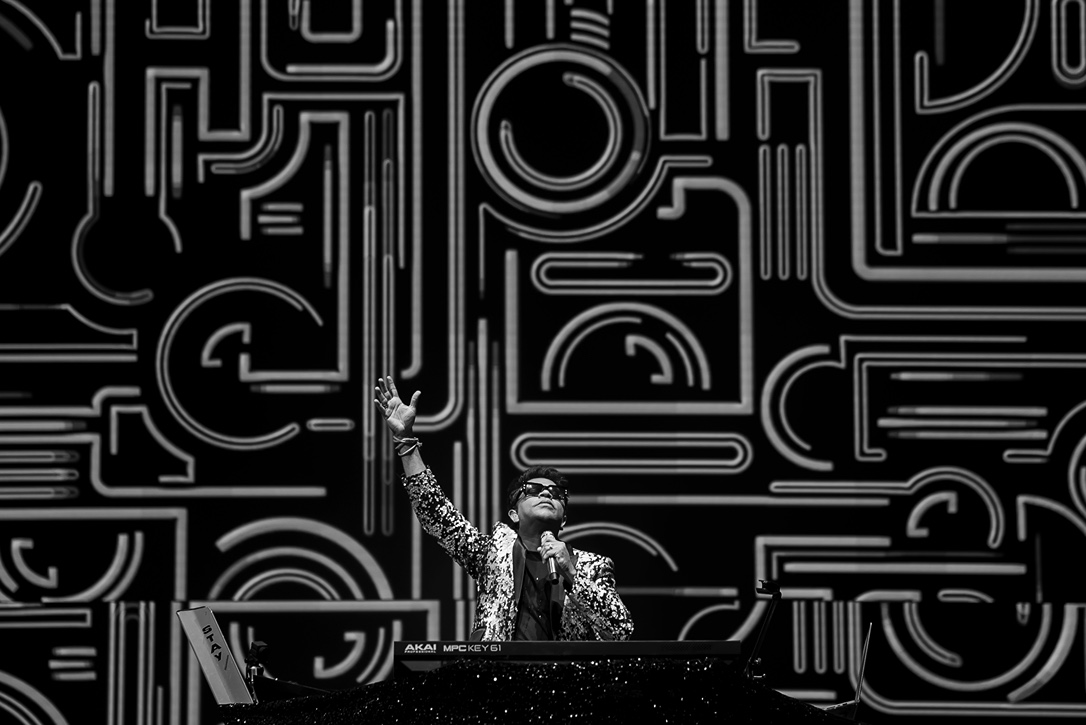
You’ve collaborated with a diverse range of artists worldwide. Do you have any particularly cherished collaborations with artists from the Middle East?
I think there are still amazing artists in the Middle East yet to be discovered. Nabyla Maan who sings with Sami Yusuf from Morocco is an incredible artist. She has also collaborated with us for Ponniyin Selvan. And on Instagram, I am discovering quite a lot of artists who I’m probably going to collaborate with very soon.
We’ve received recent reports of your collaboration to produce a ‘Fiddler on the Roof-style Musical Based on Middle Eastern folklore Character Mulla Nasruddin. – What can you tell us about the project?
The idea of you know it’s not literally Fiddler on the Roof. Mulla Nasruddin is a character which is very universal in India. I have read so many books of his exploits that showcase his wisdom and humour. The reason we said Fiddler on the Roof is because of the earthiness of the characters in the village, family, humour and the struggle for life and also finding spirituality in everything we do. So it’s still a work in progress we’re working on the script.
As technology plays an increasingly prominent role in music creation, how do you envision its impact on your creative process? Are there any specific technological advancements that excite you in the context of music production?
Technology is a tool which lets you do things you couldn’t do before. Everybody had to be physically present in a big studio to create magic. The human interaction was interesting then but now what’s nice is that everybody has a kind of studio in their house. When we need to collaborate on any specific instrument, we just call them. They can be Georgia, America or Africa and we can get the job done by syncing that sound into our system the way we need. Technology makes all these sounds so accessible.
Or I can mix something from the Netherlands sitting by the mountains while listening to my studio engineer in Chennai or LA in real-time with the workstation display instructing what should or shouldn’t be done. All these things were impossible before.
So a life getting locked into this small studio space is now free, in a way, and I love that. AI is a topic for discussion we will save up for another interview!
Is there a specific country in the Middle East where you particularly enjoy performing? If so, what makes it special?
I think the Middle East is a culmination of all cultures, at least in Dubai and Qatar and in Saudi. There are so many Indians who have been there for several generations. Most locals also understand Indian languages be it Hindi, Tamil or Urdu and enjoy the concerts. So, I love performing in the Middle East quite a lot.
Have you encountered any lesser-known musical traditions or instruments from around the world that have sparked your creative curiosity?
There are many lesser-known instruments and also the way it is now you can make anything musical – like changing the sound of a tabla into a percussion, a bird’s call into a reverberating trap cycle of music. Ideas matter now. What and where it comes from doesn’t matter anymore. The ideas and the complexity of the groove or the instrumentation evoke a feeling. I think the feeling is the most important word here.
As a prolific composer, how do you maintain your creative spark and ensure your Music continues to evolve?
Firstly, the music itself is so regenerating, then there are different ideas, collaborations etc. At the moment, I’ve also become interested in architecture because we’re building schools and shaping them into unusual buildings so that they spark curiosity in the minds of young students. Apart from that I’m also writing stories, and directing the Le Musk, which cinematic sensory experience and is going to premiere around the world in places like India, Singapore, Malaysia, Dubai, Hong Kong.
What are some of your upcoming projects that excite you and your fans should look out for?
The upcoming project is the Meta band project called Secret Mountain, we have we’re creating six virtual humans who are going to be a part of the band from India, China, Ireland, Africa, and Hispanic America. Apart from this, I have several movie projects.


