
Often overshadowed by its more famous sibling, the Tank, the Cartier Tortue is a watch that deserves far greater recognition. This understated yet elegant timepiece, named for its resemblance to a tortoise, represents a significant chapter in Cartier’s horological history.
While many associate Cartier with jewelry and luxury goods, the maison has a rich legacy as a watchmaker. The Tortue,introduced in 1912, predates even the iconic Tank by five years. Unlike the clean lines of the Tank or the rounded Tonneau, the Tortue embraced a more organic shape, inspired by nature.
In an era when most watchmakers relied on external movement suppliers like Valjoux and Lemania, Cartier took a bold step. Forming a partnership with Edmund Jaeger, the brand established the European Watch & Clock Company, dedicated to producing movements exclusively for Cartier. This strategic move allowed the maison to develop a wide range of timepieces, from simple time-only models to complex complications.

The Tortue’s potential was quickly realized. By the late 1920s, Cartier had already introduced monopusher chronograph and minute repeater versions of the watch, demonstrating a level of horological sophistication that belied the brand’s reputation as a jeweler. These early Tortues are now highly sought-after collector’s items, commanding significant prices at auction.
The Tortue’s story is a testament to Cartier’s enduring legacy as a watchmaker. While the spotlight may often fall on other models, the Tortue quietly asserts its place as a cornerstone of the brand’s horological heritage.
The Cartier Tortue Monopoussoir: A Pioneer of Complexity
Before the advent of the ubiquitous two-pusher chronograph, the monopusher reigned supreme. A testament to Cartier’s horological prowess, the Tortue Monopoussoir emerged in 1928 as a miniature marvel. Despite its compact 25mm by 35mm dimensions, this watch showcased exceptional craftsmanship. Its elegant, tortoise-inspired case housed a silver dial adorned with classic Cartier elements: Roman numerals, chemin-de-fer minute track, and blued steel Breguet hands. Two subdials, a 30-minute counter and running seconds, added functionality without cluttering the dial.
Powered by a sophisticated hand-wound movement equipped with a column wheel and horizontal clutch, this monopusher chronograph was a technical feat for its time. Produced in extremely limited numbers, this rare timepiece has become a coveted collector’s item, with examples fetching astronomical prices at auction.
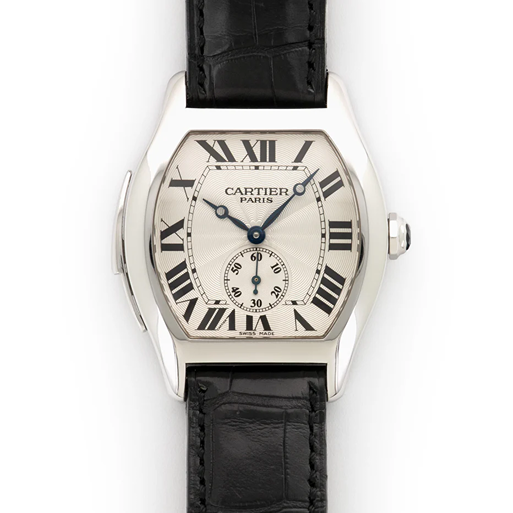
The Cartier Tortue Minute Repeater: A Masterpiece of Horology
Cartier’s pioneering spirit is evident in the Tortue Minute Repeater. Remarkably, just a decade after the wristwatch became commonplace, the brand introduced this complex timepiece. Considered one of horology’s greatest challenges, the minute repeater was mastered by Cartier in 1928, the same year it unveiled the groundbreaking Tortue Monopoussoir. This exceptional timepiece, measuring 30mm x 33mm in yellow gold, featured a discreet chiming mechanism activated by a side slider. Powered by a movement from the European Watch & Clock Company, the Tortue Minute Repeater stands as a testament to Cartier’s horological expertise. Its rarity and complexity have made it a highly coveted collector’s item, with examples achieving record-breaking prices at auction.
The Cartier Privé Collection: A Renaissance of Horology

Following a period of significant growth and the challenges posed by the Quartz Crisis, Cartier embarked on a resurgence of its horological heritage. The Collection Privée Cartier Paris (CPCP), launched in 1998, marked a pivotal moment in this journey. By collaborating with renowned watchmakers and reimagining classic models, Cartier elevated its watchmaking to new heights.
The CPCP Tortue collection showcased the brand’s commitment to technical excellence. Models like the Monopoussoir,equipped with a groundbreaking movement developed by THA, redefined the chronograph. The Perpetual Calendar, with its intricate complications, and the Tortue XL, offering innovative features like an 8-day power reserve, exemplified Cartier’s mastery of complex watchmaking.

Moreover, the brand pushed the boundaries of horology with the Tortue XL Tourbillon Chronographe Monopoussoir and Tortue Minute Repeater, showcasing its ability to create timepieces that rivaled the most prestigious haute horlogerie offerings. These models, born from collaborations with renowned watchmakers like Renaud & Papi, solidified Cartier’s position as a leading force in the industry.
Evolution of the Cartier Tortue


Following the conclusion of the CPCP era in 2008, Cartier continued to evolve the Tortue model. The brand introduced a Perpetual Calendar version in 2010, showcasing its commitment to complex complications. Subsequent years saw the release of various Tortue models, including the XL with an outsized date and the XXL Multiple Time Zones,demonstrating Cartier’s versatility in watchmaking.
Design refinements became evident in these later models. The Tortue XL, for instance, showcased a redesigned dial with a more prominent guilloché pattern and a repositioned date indicator. While some signature Cartier elements like the chemin de fer minute track were absent, the overall aesthetic was more balanced.
The Perpetual Calendar model, with its intricate display of astronomical information and partially skeletonized movement, represented a contemporary interpretation of Cartier’s watchmaking prowess. Meanwhile, the Tortue XXL Multiple Time Zones offered a unique approach to world time, combining functionality with elegance. These timepieces solidified the Tortue’s position as a cornerstone of Cartier’s collection.


The Cartier Privé Tortue: A Modern Renaissance
In 2017, Cartier revived its esteemed heritage collection, rebranding it as Cartier Privé. This platform spotlights a single iconic model each year. In 2024, the spotlight fell on the Tortue, resulting in a series of limited-edition masterpieces.These included a modern monopusher chronograph, a classic two-handed model, and a diamond-studded platinum version.
The new Monopoussoir, while retaining the classic Tortue silhouette, incorporated contemporary elements such as a sapphire caseback revealing the intricate movement. The time-only model offered a purist approach, emphasizing clean lines and elegant proportions. These reimagined Tortue models showcased Cartier’s ability to blend tradition with innovation, capturing the attention of watch enthusiasts and critics alike.
The Tortue: A Timeless Icon
With its distinctive shape, versatility, and rich history, the Cartier Tortue stands as a testament to the brand’s horological expertise. While this iconic model has long been overshadowed by other Cartier icons, it is now experiencing a well-deserved resurgence in popularity. As collectors and enthusiasts develop a deeper appreciation for the Tortue’s heritage and complexity, demand for these timepieces is steadily increasing. With its enduring appeal and potential for future development, the Tortue is poised to become an even more celebrated cornerstone in the world of watch collecting.


